Monday, June 9, 2014

Spring time common garden update

We have successfully planted 6 of our native species in all 3 of our common gardens!  Two grasses (Sorghastrum elliottii and Schizachyrium scoparium), two composites (Pityopsis graminifolia and Solidago odora), and two legumes (Tephrosia virginiana and Lespedeza capitata).  Now, let's see if we can get them established.  

It has been surprisingly difficult to go from this...


Fabric, with irrigation, installed at Coastal REC in Charleston
to this...

Planted Solidago after approximately 1 month at CREC.
and this...

Planted Pityopsis after approximately 1 month at CREC.

Thus far, the grasses have only struggled along, but the composites are doing well at all of our gardens (as you can see above).  We will have to wait and see how the legumes do since we just planted them.

Sorghastrum seedling at PDREC approximately 5 months old and just weeded.


Solidago at PDREC after 2 months in the ground.


Pityopsis at CREC after 2.5 months in the ground.

Tephrosia planted May 14th at CREC.

Lespedeza planted May 29 at SREC.

Weeding will probably be the most demanding chore during this establishment phase of our common garden study.

It may not always look like it, but we do have seedlings under all those weeds.

Heat, humidity, wind, rain, and lightning are all expected hazards, but uninvited guests and freak storms are what keep us on our toes.

A black widow in the weeds at the base of one of our grass plants at SREC.

Damaged leaflets of a Tephrosia plant at SREC, most likely caused by a hail storm the previous evening.

We found teeth marks on this section of irrigation tubing at PDREC.


Thursday, May 22, 2014

Pilot project producing native seed

We have many partners working to find and produce ecologically suitable seed for native ecosystem restoration.  This week, I met up with Vic Vankus of the USFS National Seed Laboratory to look at some small seed production plots at Taylor Nursery planted in 2012.  There is a lot of interest in the conservation and production of native seed and we are trying to learn as much as we can.  This was a good opportunity to share some of that knowledge.


Coreopsis linifolia sprouting up under some old flower stalks.

Liatris spicata 

Roots of Liatris spicata

Helianthus atrorubens

A particularly productive bed of Helianthus

We also got to take a peak at the sowing of improved longleaf pine seed going on right now at the nursery.  The folks at Taylor Nursery grow millions of tree seedlings every year!  We have even contracted the growing of thousands of wiregrass plugs with them for restoration plantings in recent years.


Thursday, May 8, 2014

A time to plant...


"To every thing there is a season, and a time to every purpose under the heaven:
A time to be born, and a time to die; a time to plant, a time to reap that which is planted" 
-King Solomon

I think we have babied these "babies" long enough!


We had to try out several treatments before deciding which combination of scarification and soaking would work for each of our legume species. 


Lespedeza capitata seed enduring a sanding treatment before soaking.

The first Lespedeza capitata germinants appear just days after planting.

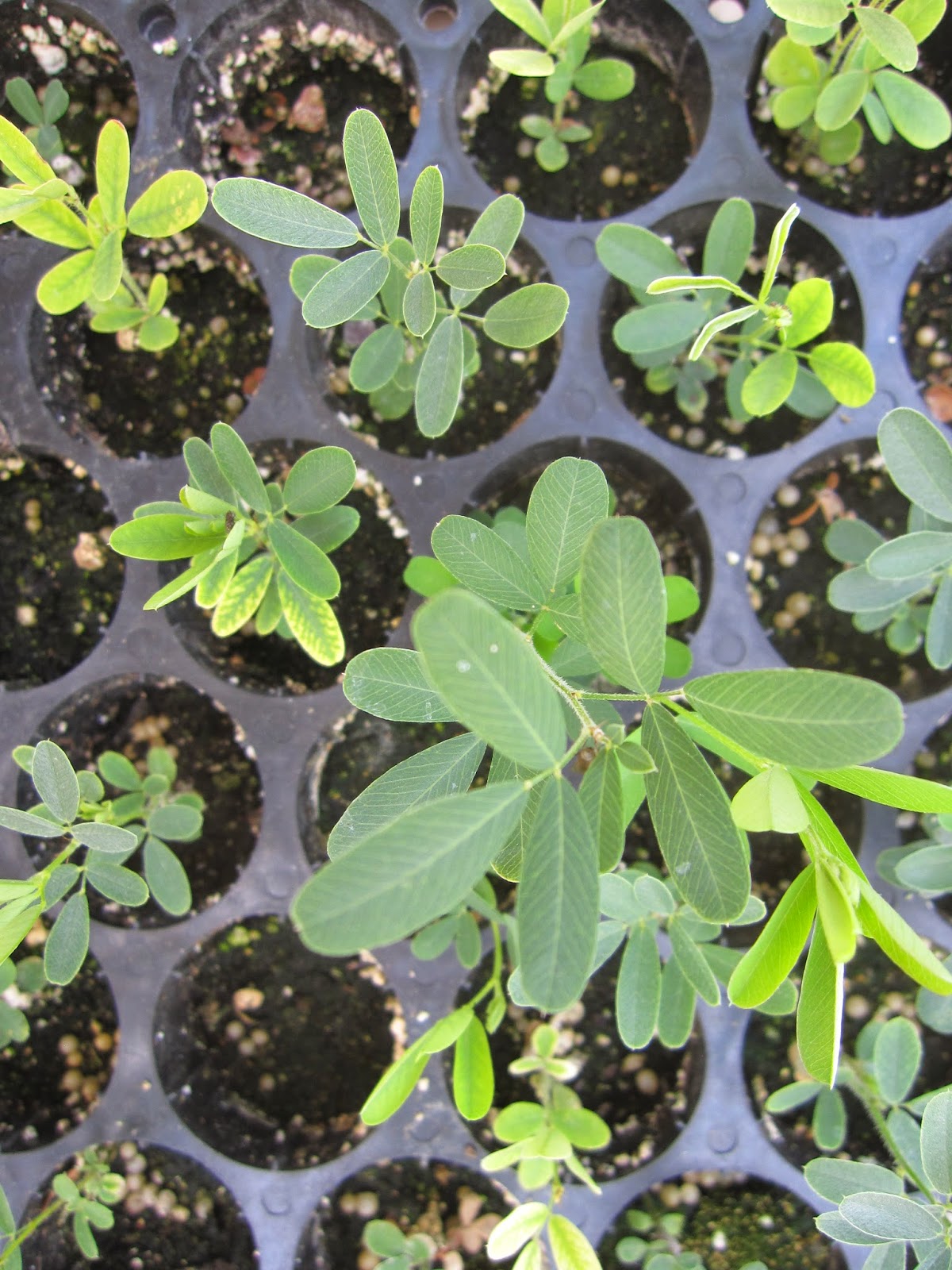
Lespedeza seedlings almost ready for their roadtrip.

Tephrosia virginiana seeds soaking.

One of our first Tephrosia germinants just popping up in the cloud forest-like propagation room.

Examining Tephrosia leaves during a recent census of our seedlings.

We are taking these Tephrosia seedlings out next week to plant at the 3 common garden sites.


Tuesday, January 7, 2014

Our first plugs are in the ground!

After months of work collecting seed from numerous field sites, cleaning seed, testing seed, sowing seed and cultivating plants in the greenhouse, we were able to plant our first set of native grass plugs.  During the month of November, Indiangrass (Sorghastrum elliottii) and Little bluestem (Schizachyrium scoparium) were the first two species planted in our common gardens.

Indiangrass just getting started in our greenhouse.

Little bluestem growing in the greenhouse at Pee Dee REC.

Common garden at Sandhill REC in Columbia, SC.

Common garden at Pee Dee REC near Florence, SC.

Common garden at Coastal REC in Charleston, SC.

Torch assembly used for burning our planting holes.

Tucking our plugs into their new home.


Lining up irrigation with planting sites.

Sunset over our common garden at Sandill REC.


Tuesday, March 12, 2013

Transplanting an endangered species

Harper’s Beauty (Harperocallis flava McDaniel) is one of the rarest of Florida’s native plants.  It is listed as “endangered” under the Endangered Species Act of 1973, and by the state of Florida. It is found in 3 panhandle Florida counties, but most of it is located on the Apalachicola National Forest. 
Harper’s Beauty occurs naturally in sedge bogs and in the edges of seepage-fed shrub bogs, which are maintained with regular prescribed burning; however, a large number of plants occupy a busy highway right-of-way.  Regular mowing has resulted in persistence of the roadside population through decades, but they are exposed to uncontrollable effects of traffic. 
We are working with partners in the US Fish and Wildlife Service, Florida Department of Transportation, Florida Natural Areas Inventory, and National Forests in Florida to develop protocols for moving Harper’s Beauty from vulnerable roadside to more secure Forest Service habitats.


Flags mark a population of Harper's Beauty along the highway.


Can you pick them out?  Even with the help of these flags it is diffcult to correctly identify the leaves of this cousin of the lilies.


Harper's Beauty is much more easily identified when it is in flower. (photo taken last spring)

   
Plants to be moved were first marked with a 10cm (4 inch) paper ring...


and then dug by hand.


A dug plug!


Plugs were tagged and wrapped in newspaper for transport.


Plants awaiting planting.


Planting grids were set in what we think will be suitable habitat.  Planting spots were marked with flags.


We counted and measured shoots in each Harper's Beauty plug.


(Jason) Planting!


Our friends from National Forests in Florida and Florida Natural Areas Inventory helped us tuck them into their new homes.  Thank you volunteers!